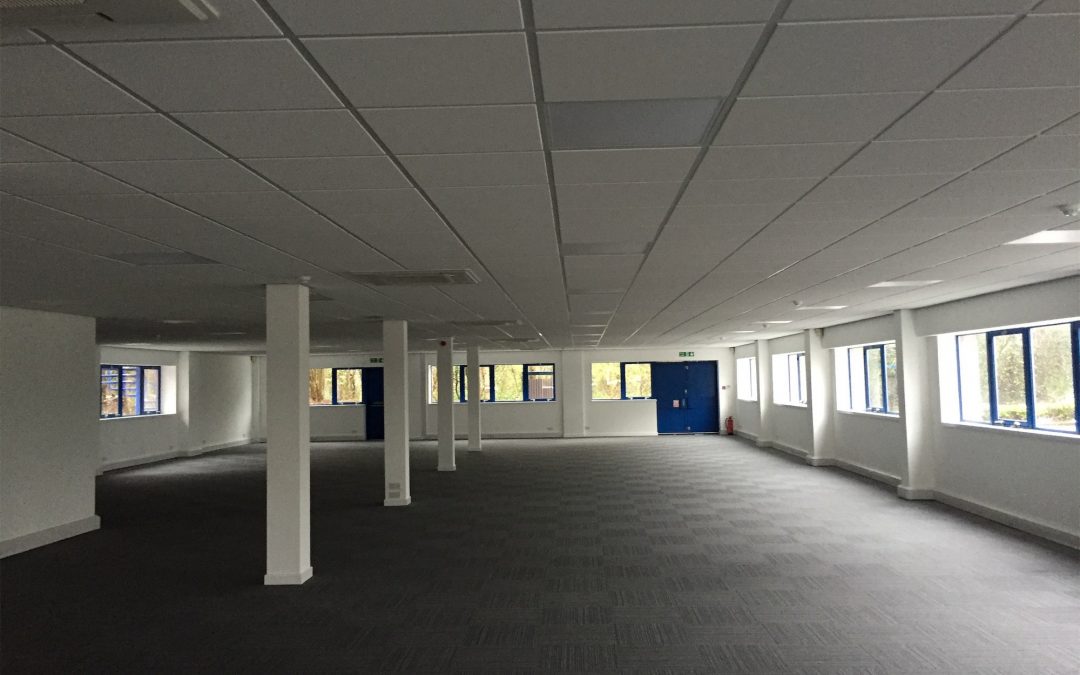
Step into almost any open-plan office in Manchester on a busy weekday morning and you will hear the same thing: phones ringing, keyboards clattering, two calls competing with a stand-up meeting, and the steady hum of air conditioning underneath it all. Businesses spend serious money on desks, lighting and breakout areas, yet the surface with the greatest influence on how a workspace sounds is usually the last one anyone thinks about. That surface is the ceiling.
In this guide, we look at why acoustic ceilings make such a difference in open-plan offices and meeting rooms, what NRC and CAC ratings actually mean, and how to choose the right acoustic ceiling tiles for your Manchester workspace.
The Numbers at a Glance
Four figures that decide how an office ceiling performs.
Why Open-Plan Offices Get So Noisy
Open-plan layouts are popular for good reason. They encourage collaboration, use floor space efficiently and suit the flexible way modern teams work. Acoustically, though, they start at a disadvantage.
Modern fit-outs are full of hard, flat surfaces: glass partitions, painted plasterboard, laminate or polished concrete floors, and exposed structural soffits. Hard surfaces do not absorb sound; they reflect it. Every conversation bounces around the room, reflections pile on top of each other, and the overall noise level creeps upward as people raise their voices to be heard. The result is a space where concentration suffers, video calls become hard work, and meeting rooms leak the very conversations they were built to contain.

How an Acoustic Ceiling Quietens a Room
The ceiling is usually the largest uninterrupted surface in an office, which makes it the single most effective place to tackle noise. An acoustic suspended ceiling replaces that hard, reflective plane with tiles engineered to absorb sound energy rather than bounce it back into the room.
Because the tiles sit within a lightweight grid, you keep every practical benefit of a suspended ceiling: concealed cabling and ductwork, easy access for maintenance, integrated lighting and better thermal performance.
Acoustic tiles simply add one more job to that list, soaking up the sound of voices, phones and office equipment before it can travel across the floor.
NRC and CAC Ratings Explained
Two ratings tell you most of what you need to know when comparing acoustic ceiling tiles.
NRC (Noise Reduction Coefficient) measures how much sound a tile absorbs. It runs from 0 to 1 and can be read as a percentage: a tile rated NRC 0.70 absorbs roughly 70 per cent of the sound that strikes it. For general open-plan areas, look for NRC 0.70 or above. For call-heavy teams, boardrooms and video conferencing suites, tiles rated between NRC 0.85 and 0.95 are worth the extra investment. On UK and European datasheets you may also see an absorption class from A to E under BS EN ISO 11654, with Class A offering the highest level of absorption.
CAC (Ceiling Attenuation Class) measures something different: how well a ceiling blocks sound travelling from one room to the next through the open void above the grid. It is expressed in decibels, and higher is better. Where partition walls stop at the ceiling grid rather than continuing up to the structural soffit, sound can simply travel up, over and into the neighbouring room. A ceiling rated CAC 35 or above is generally considered high performance and is the sensible starting point for meeting rooms, HR offices and anywhere confidentiality matters.
| Rating | What it measures | What to aim for |
|---|---|---|
| NRC | How much sound a tile absorbs within the room (0 to 1) | 0.70+ for open-plan areas; 0.85 to 0.95 for boardrooms and call-heavy teams |
| CAC | How well the ceiling blocks sound passing between rooms through the ceiling void (in dB) | 35+ for meeting rooms and offices where privacy matters |
The two ratings pull in different directions, because the soft, porous materials that absorb sound well are not always the best at blocking it. The right specification usually balances both, which is exactly the sort of judgement an experienced installer brings to your project.
Choosing the Right Acoustic Ceiling Tiles
Acoustic performance comes in more finishes than most people expect. These are the acoustic ceiling tiles Manchester businesses choose most often:
Mineral fibre tiles.
The workhorse of commercial ceilings. Cost-effective, widely available and offering solid absorption, they suit most general office areas and are easy to replace if a tile is ever damaged.
Glass wool and soft fibre tiles.
Lightweight tiles with outstanding absorption, often reaching NRC 0.90 and above. Ideal for boardrooms, video conferencing suites and busy sales floors where clarity of speech really matters.
Perforated metal tiles with acoustic fleece.
A crisp, contemporary look with hidden absorbent backing. Durable and easy to wipe clean, they work well in reception areas and high-traffic spaces.
Plasterboard and MF ceilings with acoustic backing.
Where a seamless, monolithic finish is wanted, a metal frame ceiling can be combined with absorbent insulation and perforated boards to deliver quiet without a visible grid.
Whichever route you take, a good tile earns its keep in more ways than one. Many acoustic ranges also offer high light reflectance, which brightens the office and reduces lighting costs, alongside fire performance and humidity resistance appropriate to the space.
What Difference Will You Actually Hear?
The most useful measure here is reverberation time: how long a sound hangs in the air before it dies away. In an untreated office full of hard surfaces, reverberation time can sit well above one second, which is why such rooms feel echoey and tiring. A well-specified acoustic ceiling typically brings that down to around half a second. Speech stops carrying across the floor, calls become clearer at both ends, and the general background hubbub drops to a level people can comfortably work over.
The honest answer on soundproofing
A word of honesty is needed on terminology. No ceiling tile makes a room silent, and truly soundproofing a space is a specialist structural job. But when people search for a soundproof office ceiling, what they usually want is exactly what a good acoustic ceiling delivers: conversations that stay at the desk where they started, meetings that stay in the meeting room, and an office that sounds calm rather than chaotic.


Meeting Rooms: Where Ceilings and Partitions Work Together
Meeting rooms deserve special attention because they have two acoustic jobs at once: keeping noise out so people can think, and keeping conversations in so sensitive discussions stay private. High-CAC ceiling tiles handle the path over the top of the walls, while the walls themselves do the rest. That is why we often pair acoustic ceilings with our partition walls service. Designing the two together, as one specification from one team, avoids the classic mistake of fitting an excellent partition beneath a ceiling that lets sound sail straight over it.

Acoustic Ceiling Installation Across Manchester and the North West
S.F. Ceilings has been installing suspended and acoustic ceilings across Manchester and the North West since 1983. Our teams are CSCS carded, CHAS Accredited and Safe Contractor Approved, and we regularly work out of hours or in phases so your office keeps running while the work goes in. You can read more about us or browse recent office installations in our project gallery.
Get a Quieter Office
If noise is wearing your team down, an acoustic ceiling is one of the quickest and least disruptive upgrades you can make, and one of the few that pays you back every single working day. We offer free, no-obligation site visits, advice and quotes.
Call us on 0161 335 0980, email info@sfceilings.co.uk, or send us a message through our contact form to arrange your free consultation.